
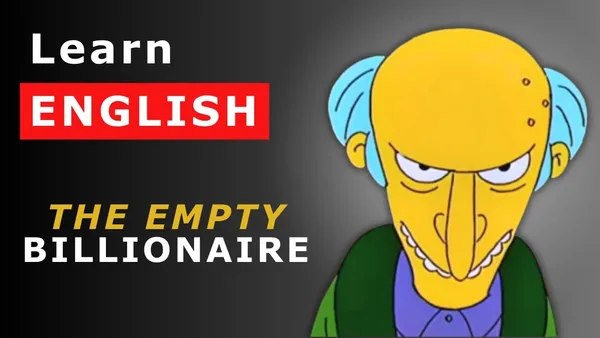
B2 Identity & Self
Con man, bona fide, mob mentality: the language of charm and persuasion from one of the greatest Simpsons episodes ever written.
Marge vs. the Monorail is one of the most loved episodes in Simpsons history, written by Conan O’Brien before he became a talk-show host. It stars Phil Hartman as Lyle Lanley, a smooth-talking con man who sells a shiny, useless monorail to an entire town. This lesson breaks down the language of charm, persuasion, and mob mentality.
Key Terms
■ A con man is someone who wins people’s trust in order to deceive them. Short for “confidence man”. As a verb, to con means to trick someone.
✔ Works as both a noun and a verb. Related words: con artist, scam, swindle.
► “Lanley conned the entire town into buying a useless monorail.”
► “Watch out, that salesman is a total con man.”
■ To be ordered to pay money as a punishment for breaking a law or rule.
✔ The noun is “fine”. Common in legal and news contexts. Worth noting: there is nothing “fine” about it.
► “Mr. Burns was fined three million dollars for dumping toxic waste.”
► “She was fined for parking in the wrong spot.”
■ A situation where reality is the opposite of what you would expect.
✔ Very common in English conversation, comedy, and criticism. Do not confuse with sarcasm, which is intentional.
► “It is ironic that Homer complains about potholes when he helped cause them.”
► “The irony is that the monorail was supposed to modernise the town but destroyed it.”
■ Something or someone that causes repeated annoyance, inconvenience, or trouble.
✔ Slightly formal but widely used. Can refer to people, situations, or things.
► “Marge calls the potholes a nuisance that the town needs to fix.”
► “Those roadworks have been a nuisance for months.”
■ Genuine, authentic, and legitimate. From Latin, meaning “in good faith”.
✔ Used to emphasise that something is the real thing. Often used in formal or emphatic speech.
► “Lanley called it a genuine, bona fide, electrified, six-car monorail.”
► “She is a bona fide expert, not just someone who read a blog post.”
■ To make a place, person, or thing famous or well known.
✔ Idiomatic. Often used in marketing or when something brings attention to a previously unknown place.
► “Lanley claims the monorail put Brockway, Ogdenville, and North Haverbrook on the map.”
► “Winning the championship really put that small town on the map.”
■ The tendency for people in a group to follow the crowd and stop thinking independently. Emotion takes over and reason disappears.
✔ Used in psychology, media, and everyday analysis of group behaviour. Related: herd mentality, groupthink.
► “The crowd drowns out Marge’s concern, classic mob mentality.”
► “Social media can trigger mob mentality very quickly.”
■ Easy, comfortable, and well paid, usually referring to a job or situation that requires little effort.
✔ Informal. Slightly envious or mocking in tone.
► “Lanley promises cushy jobs for everyone on the monorail.”
► “He landed a cushy office job right after graduation.”
■ Honest, straightforward, and trustworthy. Not hiding anything.
✔ Informal, slightly old-fashioned. Used to reassure someone that you are being straight with them.
► “Lanley says he is on the level, but he is absolutely not.”
► “Is this deal on the level, or is there something they are not telling us?”
■ A humorous imitation of something that exaggerates its features for comic effect.
✔ Common in film, literature, and comedy. Different from satire (which criticises) and spoof (which is sillier).
► “The Monorail episode is a parody of The Music Man, a classic American musical.”
► “Airplane! is a parody of disaster films from the 1970s.”
1. What does the phrase “I swear” mean when someone says it to sound convincing?
a) I promise or I am telling the truth
b) I am making a joke
c) I am asking a question
2. What does it mean to “put a place on the map”?
a) To literally draw it on a map
b) To make it famous or well known
c) To remove it from a map
3. What is mob mentality?
a) When people follow the crowd without thinking
b) When a crowd holds a peaceful debate
c) When everyone thinks independently
4. Why is Marge’s comment about potholes ironic?
a) Because Homer probably caused most of them
b) Because the town has no roads
c) Because she does not really care about the roads
Answers: 1-a, 2-b, 3-a, 4-a
Download the vocabulary breakdown sheet — definitions, examples, and exercises you can actually study with.